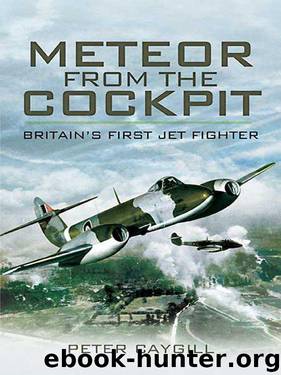
Meteor from the Cockpit: Britain’s First Jet Fighter by Peter Caygill
Author:Peter Caygill [Caygill, Peter]
Language: eng
Format: epub
Tags: Bisac Code 1: HIS027140
ISBN: 9781844683352
Publisher: Casemate Publishers
Published: 2012-07-12T07:00:00+00:00
CHAPTER 11
Accidents and Incidents
During its long RAF career approximately twenty-five per cent of all Meteors were written off in accidents, which included 150 in 1952 alone. This was not due to any particular problem with the aircraft itself but rather more to the way it was operated. This chapter describes some of the more common Meteor accidents and incidents (all times in the following accounts are ‘Zulu’ or GMT).
ASYMMETRIC ACCIDENTS
Throughout this book the first-hand accounts by former Meteor pilots make frequent reference to the difficulties of flying the aircraft on one engine at the lower end of the speed range. The policy of carrying out single-engine approaches to practise for the possibility of losing an engine was to be the biggest killer as far as the Meteor was concerned. Ironically, by the early 1950s the Derwent was an extremely reliable engine and the chances of having to land a Meteor on one engine were relatively low. The following descriptions of landing accidents with one engine throttled back give an idea of the risks involved in operating the Meteor in the engine-out condition.
As an introduction to flight with one engine shut down, training was usually commenced at 5,000 ft with a simulated asymmetric circuit in which the ground was assumed to be 1,000 ft below the aircraft’s height. Using a line feature as a ‘runway’, the aircraft was placed in the downwind position with undercarriage and 1/3 flap down, with one engine throttled back and 12,500 rpm on the other. This exercise was split up into two parts, and during the first part, at the end of the downwind leg, the aircraft was turned through 180 degrees onto the simulated runway with approximately 11,000 rpm on the live engine. At this stage the rate of descent (1,200 ft/min) was pointed out to the student, and at the end of the turn more power was applied. The student was then made aware that the rate of descent had been checked and that with undercarriage and 1/3 flap down an overshoot could be carried out, and by lowering the nose and allowing the speed to build up to 165–170 knots, a rate of climb of approximately 500 ft/min could be maintained. This part of the sequence was usually carried out with the starboard engine throttled back, thus simulating exhaustion of the hydraulic accumulator.
For the second part of the exercise the port engine was throttled back so that hydraulic services were retained, thus allowing the undercarriage and flaps to be retracted as required. Once again the aircraft was positioned on a simulated downwind leg, but on this demonstration the airbrakes were left out. The turn was carried out as before, using 11,000 rpm on the starboard engine, and this manoeuvre was flown at an indicated airspeed of 150 knots. With the airbrakes out, the rate of descent was increased significantly and was usually around 2,000 ft/min, so that 1,000 ft was lost in the first ninety degrees of turn, thereby bringing the aircraft down to assumed ground level.
Download
This site does not store any files on its server. We only index and link to content provided by other sites. Please contact the content providers to delete copyright contents if any and email us, we'll remove relevant links or contents immediately.
| Africa | Americas |
| Arctic & Antarctica | Asia |
| Australia & Oceania | Europe |
| Middle East | Russia |
| United States | World |
| Ancient Civilizations | Military |
| Historical Study & Educational Resources |
Room 212 by Kate Stewart(5183)
The Crown by Robert Lacey(4861)
Endurance: Shackleton's Incredible Voyage by Alfred Lansing(4844)
The Iron Duke by The Iron Duke(4404)
The Rape of Nanking by Iris Chang(4255)
Joan of Arc by Mary Gordon(4155)
Say Nothing by Patrick Radden Keefe(4042)
Killing England by Bill O'Reilly(4041)
I'll Give You the Sun by Jandy Nelson(3496)
Shadow of Night by Deborah Harkness(3407)
Hitler's Monsters by Eric Kurlander(3384)
Mary, Queen of Scots, and the Murder of Lord Darnley by Alison Weir(3240)
Blood and Sand by Alex Von Tunzelmann(3238)
Eleanor & Park by Rainbow Rowell(3233)
Darkest Hour by Anthony McCarten(3161)
Margaret Thatcher: The Autobiography by Thatcher Margaret(3113)
Book of Life by Deborah Harkness(2983)
Red Famine: Stalin's War on Ukraine by Anne Applebaum(2968)
The One Memory of Flora Banks by Emily Barr(2898)
